23 April, 2026
Mobile-Punch
SHARE
Mobile Punching consent form in construction: what the CCQ requires
Since March 2023, mobile punching has been officially permitted on construction jobsites in Quebec, under one clear condition: the employer must obtain written consent from every employee who uses it. This document is not optional. It’s built into the collective agreements (in french) currently in force, and failing to have it exposes the employer to sanctions. Here’s what this form needs to contain, where to find it depending on your sector, and how to manage it without bogging down your administration.
Why a consent form is mandatory
In March 2023, arbitrator Alain Turcotte issued a ruling that definitively clarified the status of mobile punching applications in the construction industry. Punching in through an application installed on a smart electronic device (whether provided by the employer or belonging to the employee) is now permitted, but only if the worker consents freely and in writing. Before this decision, mobile punching applications were considered contrary to the collective agreements, following an earlier arbitration ruling from November 2020.
This consent requirement rests on two legal foundations. First, the collective agreements themselves, which have incorporated specific schedules to frame the use of mobile punching. Second, Law 25 on the modernization of rules governing personal information, which requires informed and explicit consent whenever a business collects location data.
Without a signed form, the use of a mobile punching application is non-compliant. An employee, a union, or the CCQ can report the situation, and the employer faces a statement of offence under section 120 of Act R-20.
What the form must contain
The content of the form is framed by the collective agreements. An improvised or makeshift document is not enough: it must follow the structure and wording set out in the sector-specific schedules.
A compliant form includes at minimum the following elements.
-
- Identification of the parties. The employer’s name, the employee’s name, the name of the mobile application provider, and the name of the application itself must appear at the top of the document.
- The employee’s declared choice. Two options must be clearly presented: accepting the use of the application with geolocation, or refusing it and using the alternative method provided by the employer.
- Description of the information collected. The form must specify that only the employee ID and a single geolocation point within a 1,150 feet around the place where work hours begin and end may be captured, and only at the moment the employee punches in or out.
- Non-retaliation clause. The employee must be informed in writing that they can refuse the application or stop using it at any time without facing any disciplinary action.
- Description of the alternative method. If the employee refuses, the employer must indicate the backup system available (mobile time tracking, paper time card, or electronic time card).
- Signature of the employee and the employer’s representative, along with the date.
Where to find the official form for your sector
Each sector of the industry has its own form, with distinct references in the collective agreements:
- Residential sector: Schedule W-1, published by the APCHQ
- Institutional-commercial and industrial sectors (IC/I): Schedule N-1, published by the ACQ
- Civil engineering and roadworks sector: Schedule Z-7-1, published by the ACRGTQ
The 2025-2029 collective agreements carry over these same schedules. Employers who were already using a compliant form in 2021-2025 don’t need to replace it, but they should verify that the section references cited (for example, section 18.01 for residential or section 20.04.1 for civil engineering and roadworks) correspond to the updated clauses in the new agreement.
The employer associations make the official versions available on their respective websites. It is strongly recommended to use these versions rather than an unvalidated third-party template.
The rules governing geolocation
On this point, the 2023 arbitration ruling and the schedules to the collective agreements leave no room for interpretation.
- Continuous geolocation is strictly prohibited. It can only be activated when the employee presses the punch button.
- The maximum tolerated radius around the job site is 1,150 feet.
- No personal data other than the employee ID and the single location coordinate may be collected.
- The information collected must be anonymized and stored in Quebec, in accordance with the current IT security standards.
- Providers chosen by the employer for a mobile punching application, or to host the personal information collected, must hold a certification recognized in Canada attesting to the security of personal information and compliance with current laws. The certifications accepted are: ISO 27001, SOC 2 Type 1 and 2 audits, and CyberSecure Canada.
In practical terms, a compliant application cannot track an employee while they travel between jobsites, during their breaks, or outside their work hours. It only operates at the specific moments of the punch in and the punch out.
What if an employee refuses to consent?
An employer cannot impose mobile punching. If a worker refuses, the employer must offer an alternative method: a fixed time clock installed as close as possible to the place where work hours begin, a paper time card, or an electronic time card.
An employee’s refusal can never lead to disciplinary action, loss of hours, refusal to hire, or any other retaliatory measure. This is an absolute rule that applies both at hiring and throughout employment.
An employee who initially consented can also, at any time, notify the employer that they are stopping use of the application. The employer must then immediately provide an alternative method, with no justification required.
The risks of not using the form
Employers who use a punching application without having collected signed consents expose themselves to several risks.
- Penal offence under Act R-20: fines range from $207 to $1,005 for an individual, and from $770 to $3,317 for a corporation. These amounts can be increased for repeat offences.
- Complaint under Law 25: the Commission d’accès à l’information can order corrective measures and impose administrative monetary penalties that can reach tens of thousands of dollars for a business.
- Union grievance that may lead to an unfavourable arbitration ruling and compensation owed to employees.
- Timesheet invalidation: if consent is challenged, the declared hours can be called into question, which complicates production of the CCQ monthly report and verification of contributions.
Simplifying consent management with a compliant application
The consent form must be signed by every employee and kept by the employer, ideally in a centralized and traceable way. A mobile punching application that complies with the arbitration ruling integrates this process directly into employee onboarding. At Mobile-Punch, to make life easier for both employees and employers, the form is built into the application and is signed digitally before first use, archived in the employee’s file, and accessible at any time in the event of a CCQ audit. Geolocation is strictly limited to the moment of the punch, the data is hosted in Quebec, and the application meets the requirements of Law 25. Mobile-Punch also holds the CyberSecure Canada certification, recognized nationwide, which attests to the security of personal information and compliance with current laws. The Mobile-Punch timesheet application is also compliant with Act R-20, giving peace of mind to contractors who need to produce their monthly reports to the CCQ.
For contractors managing teams across multiple jobsites, this centralization makes all the difference between time-consuming administration and built-in compliance, especially at a time when CCQ audits are becoming more frequent and preventing buddy punching has become a major governance issue.
Recent Articles
7 October, 2026 • Mobile-Punch
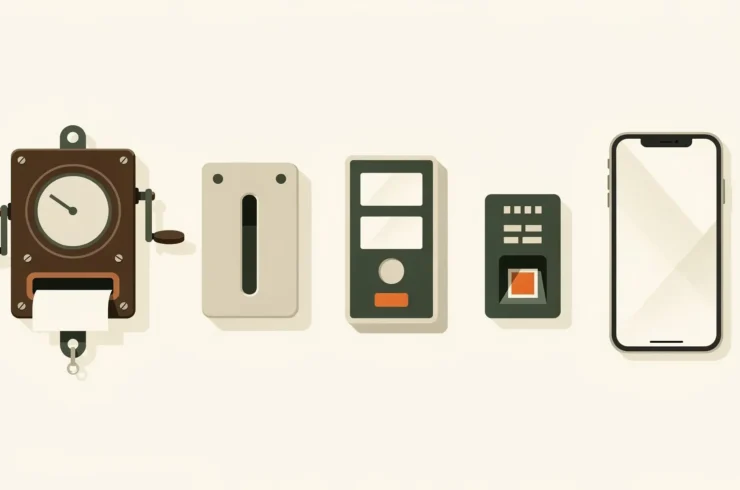
The evolution of time clocks: from Bundy clocks to mobile time tracking
Every hour worked but poorly recorded costs money, distorts payroll and fuels disputes. For more than a century, employers have…

8 September, 2026 • Mobile-Punch
R-20 Compliant Timesheet: How to Keep It Right? A Guide for Construction Employers
On a job site governed by Bill R-20, the timesheet is not just an internal management tool: it is the…

28 July, 2026 • Mobile-Punch
CCQ Travel Expenses: How to Automate Mileage Calculations? An Employer’s Guide
In Quebec’s construction industry, CCQ travel expenses show up on your workers’ pay every single week. The amount you owe…