7 October, 2026
Mobile-Punch
SHARE
The evolution of time clocks: from Bundy clocks to mobile time tracking
Every hour worked but poorly recorded costs money, distorts payroll and fuels disputes. For more than a century, employers have therefore been looking for a reliable answer to a simple question: who worked, where and for how long? From the first mechanical time clock, the Bundy clock of 1888, to the geolocated mobile time tracking you keep in your pocket, every generation of tools has pursued the same goal: to measure working time accurately and reduce errors. For an HR manager, a decision-maker or a field team supervisor, this shift is far from trivial: it explains why paper timesheets are living their final years.
This article traces the evolution of time clocks, from the first punch-card systems to biometrics and mobile time tracking. You will see how each technology addressed the limits of the previous one, what these systems concretely change for payroll and time and attendance, and how to choose a tool today that is suited to teams on the move.
What is a time clock?
A time clock is a device, or today an app, that records an employee’s arrival and departure time in order to calculate their working time. The principle has not changed since 1888: you record a reliable timestamp, tied to a person, to produce an accurate timesheet. What has changed is the technology used to capture that moment: a mechanical punch yesterday, a fingerprint or a GPS signal today. Depending on the era and the country, it is also called a time clock system, a punch-clock or a time stamp machine.
1888: the Bundy clock, the first mechanical time clock
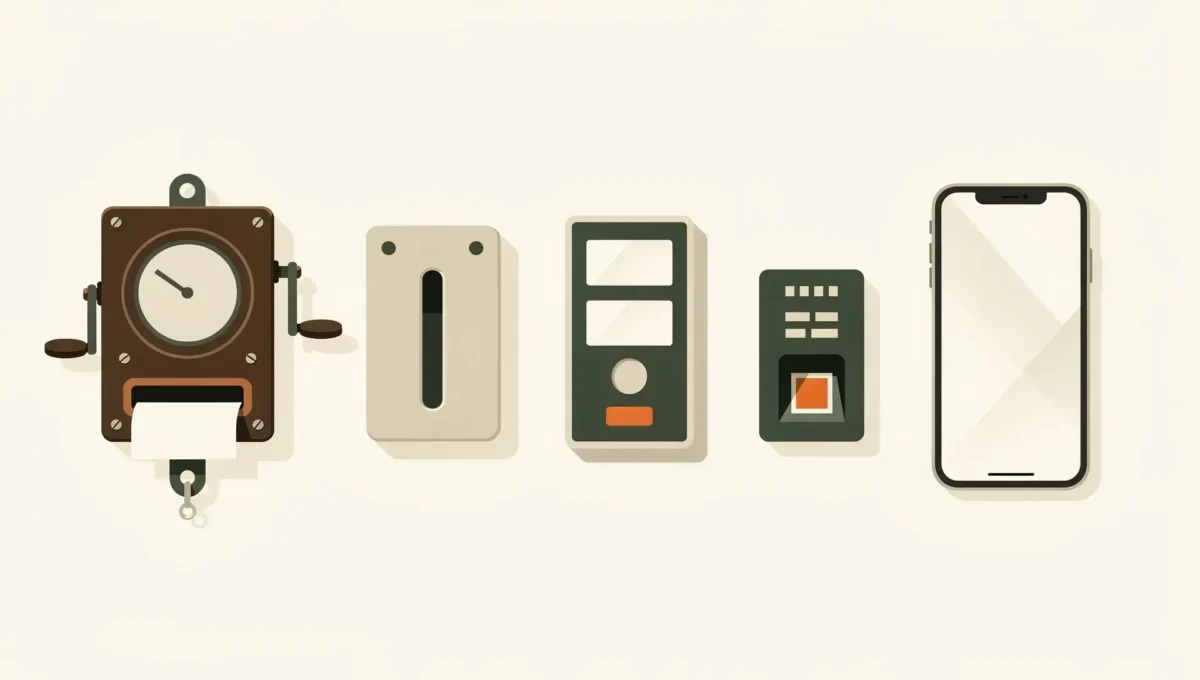
The Bundy clock of 1888 is among the first modern mechanical time clocks. That year, the American jeweller and inventor Willard Le Grand Bundy developed a mechanical recorder of working time in Binghamton, in the state of New York. Each employee had a numbered key: by inserting it into the device, it printed the exact time and their number on a paper tape. In 1889, his brother Harlow E. Bundy founded the Bundy Manufacturing Company, the first company in the world to manufacture time clocks on an industrial scale.
The contribution of the Bundy clock goes beyond simple mechanics. For the first time, the recorded time was no longer a matter of trust or memory: it was logged impartially by the machine. This changed the working relationship by providing an objective basis for calculating wages and by reducing disputes over hours worked. The name has remained in everyday language: in several English-speaking countries, such as Australia, clocking in is still called punching the Bundy.
From the key to the punch: the era of punch-card time clocks
At the turn of the 20th century, the system evolved toward the punch card. Each employee received a cardboard card, often divided into columns corresponding to the days of the week. At the start and end of a shift, they slid their card into the time clock, which printed the time on it. At the end of the pay period, the employer added up the hours recorded on each card.
This approach became widespread because it was robust, legible and inexpensive. The Bundy companies even joined with other manufacturers: in 1900, they formed the International Time Recording Company (ITR), which merged in 1911 into the Computing-Tabulating-Recording Company (CTR). In 1924, that company took on a name destined to become famous: IBM. The time clock therefore stands, quite literally, at the origin of one of the biggest names in computing.
The punch card had one flaw, however: it did not verify the identity of the person punching in. A colleague could punch an absent worker’s card, a practice known today as time theft or buddy punching.
How did time clocks become digital?
Time clocks became digital by replacing paper with magnetic-stripe cards, then with contactless RFID cards and electronic memory. Starting in the 1970s and 1980s, electronic time clocks gradually replaced certain mechanical systems. They could calculate hours automatically and store data electronically, then transmit it to computer systems.
Identification technologies then evolved with magnetic cards, followed by contactless electronic badges, notably RFID technologies, with the system recording the entry without manual intervention.
The gains were concrete: fewer manual calculations, fewer transcription errors and a consultable history. But one problem remained. A card, whether magnetic or RFID, only proves that a badge was presented, not who presented it. Buddy punching remains possible as long as the device does not verify the person’s actual identity.
Biometrics: how did the fingerprint and the face replace the card?
To tie the punch to a person with certainty, manufacturers turned to biometrics. Instead of a badge, a unique physical characteristic is used: the fingerprint, the shape of the hand or, more recently, facial recognition. Because this characteristic cannot be lent to a colleague, biometrics can considerably reduce the risk of time theft and makes time and attendance more reliable.
Note: in Quebec, the use of biometrics is subject to specific requirements regarding the protection of personal information. Consent must, in particular, be manifest, express, free, enlightened, specific and limited in time. Another means of identification must be offered. The use of a biometric process must also be disclosed to the Commission d’accès à l’information. When a bank of biometric characteristics or measurements is created, its commissioning must be declared at least 60 days in advance. Validate your obligations before deploying such a system.
Mobile time tracking: the time clock in your pocket
The latest step removes the fixed device. With mobile time tracking, it is the employee’s smartphone, or a tablet installed on the job site, that becomes the time clock. The worker punches in directly at the place of work, without going through the office. Each entry can be timestamped and tied to the position of the phone or tablet. Geolocation thus makes it possible to verify that the punch was made within the authorized zone.
This approach is particularly well suited to teams on the move: construction job sites, transport fleets, service technicians, maintenance. The data flows back in real time to the office, feeds directly into the timesheet and exports to accounting software. Time tracking stops being an end-of-month chore and becomes reliable data, available continuously. We detailed these benefits in our article on real-time time management for mobile teams.
What are the major milestones in the evolution of time clocks?
The table below summarizes the major eras of time tracking, the associated technology and its main limitation.
Why does this evolution matter for managers and decision-makers?
Because the reliability of the hours punched directly determines the accuracy of payroll, compliance and the profitability of operations. For an HR department, an inaccurate timesheet means a payroll error and a risk of dispute. For a decision-maker, it means an invisible loss of margin. In Quebec construction, the hours declared are also used to calculate contributions and the reports sent to the Commission de la construction, which makes accuracy even more critical.
In concrete terms, a modern time clock delivers several measurable benefits:
- Accurate hours: automatic timestamping replaces estimates from memory and reduces calculation errors.
- Reduce the risk of buddy punching: geolocation and, where appropriate, biometrics can reduce the risk of buddy punching between colleagues.
- Simplified hour calculation: regular hours, overtime and travel are added up automatically, as a work hours calculation app does.
- Greater payroll accuracy: the data exports without manual transcription, which reduces corrections. See our article on payroll processing accuracy.
- A continuous field-to-office view: the hours also feed into project management and the progress tracking of your jobs.
How to choose a mobile time clock suited to field teams?
Not all time tracking apps perform equally in the field. For mobile teams in Quebec, a few criteria matter more than others: geolocation to confirm presence at the right place, an offline mode for areas without a network, export to Quebec accounting and payroll software, and, in construction, a compliant timesheet under Bill R-20 and the collective agreements.
This is precisely the purpose of an app like Mobile-Punch. Designed in Quebec for construction companies and adapted to other sectors, it records hours by job site and by project code, in real time, with a geolocated timestamp. The data exports to the main accounting software (Acomba, Employeur D, Nethris, Avantage, and others) and feeds directly into payroll and project management. Hesitating between two solutions? Our comparison of Mobile-Punch and ProgressionLIVE and our selection of the best time tracking apps can help you decide.
A mobile time tracking tool replaces neither your payroll department nor the applicable rules, but it makes the raw material of the calculation more reliable: the hours. Tools like Mobile-Punch were designed so that compliance becomes a natural consequence of the way you work, rather than an end-of-month chore.
FAQ: frequently asked questions about time clocks
Who invented the time clock?
The first time clock was invented in 1888 by Willard Le Grand Bundy, in the United States. His brother Harlow founded the Bundy Manufacturing Company in 1889, the first company to manufacture time clocks in series. This line of companies would give rise to IBM in 1924.
What is the difference between a time clock and a badge reader?
The two terms often refer to the same type of device. A time clock records working time; a badge reader is a time clock that uses a badge (magnetic or RFID card) to identify the employee. Today, mobile time tracking replaces the badge with the phone and geolocation.
Is mobile time tracking legal in Quebec?
Yes, mobile time tracking can be used in Quebec, but its deployment must comply with the applicable rules on the protection of personal information. When a technology makes it possible to locate a person, the company must, in particular, inform them beforehand and comply with the requirements applicable to the collection, use and retention of personal information. Geolocation must also be limited to what is necessary for the intended purposes. The requirements are especially strict when it comes to biometric data.
Is a mobile time clock suited to small businesses?
Yes. Since there is no fixed device to install, a mobile time tracking app suits a team of three people just as well as a large job site. The cost is proportional to the number of users and the tool grows with the business.
Would you like to see how Mobile-Punch can modernize time tracking for your teams?
Recent Articles
8 September, 2026 • Mobile-Punch
R-20 Compliant Timesheet: How to Keep It Right? A Guide for Construction Employers
On a job site governed by Bill R-20, the timesheet is not just an internal management tool: it is the…

28 July, 2026 • Mobile-Punch
CCQ Travel Expenses: How to Automate Mileage Calculations? An Employer’s Guide
In Quebec’s construction industry, CCQ travel expenses show up on your workers’ pay every single week. The amount you owe…

11 June, 2026 • Mobile-Punch
Mobile-Punch vs ProgressionLIVE: which software should you choose to manage your field teams?
Choosing software to manage your field teams is never a trivial decision. A handful of solutions exist in Quebec and…